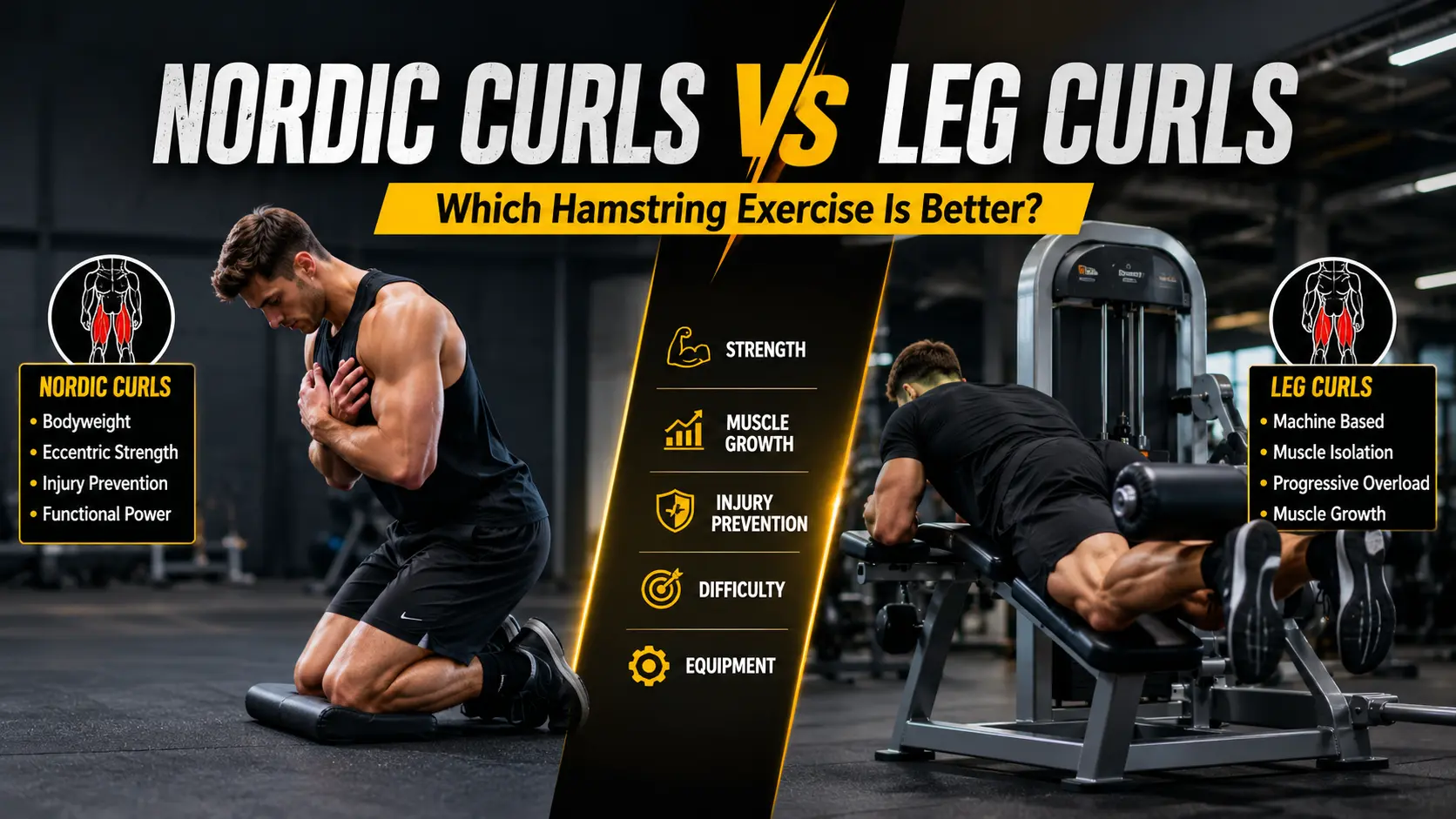
 Where hamstrings strengthening, improving athletic performance, and preventing injuries are concerned, two exercises stand out above all else, which are Nordic curls and leg curls.
Chances are, if you’ve frequented a gym before or looked into hamstrings training, you’ve come across a discussion of one exercise being better than another. One side believes Nordic curls are superior when it comes to building muscles, whereas another holds that leg curls isolate muscles more effectively.
The reality is that both workouts bring something to the table, yet their functions are different. The more you learn about how each type of workout works, the easier it will be for you to pick the right one according to your goals. Whether it’s getting better at sprinting or growing larger legs, both types of exercises have their own advantages.
Here, we will take a closer look at Nordic curls vs leg curls and highlight their pros and cons.
What Are Nordic Curls?
Nordic curls, also known as Nordic hamstring curls, are a bodyweight exercise that focuses heavily on eccentric hamstring strength.
How Nordic Curls Work
- Kneel on a padded surface.
- Anchor your ankles securely.
- Keep your body straight from head to knees.
- Slowly lower yourself toward the floor.
- Use your hands to catch yourself if necessary.
- Return to the starting position.
Primary Muscles Worked
- Hamstrings
- Biceps Femoris
- Semitendinosus
- Semimembranosus
- Glutes
- Calves
- Core Stabilizers
What Are Leg Curls?
Leg curls are a machine-based exercise designed to isolate the hamstrings through knee flexion.
Types of Leg Curl Machines
- Seated Leg Curl Machine
- Lying Leg Curl Machine
- Standing Leg Curl Machine
How Leg Curls Work
- Position yourself on the machine.
- Place the resistance pad against your lower leg.
- Curl the weight toward your body.
- Slowly return to the starting position.
Primary Muscles Worked
- Hamstrings
- Gastrocnemius (Calf Muscle)
- Minor Stabilizing Muscles
Nordic Curls vs Leg Curls: Key Differences
1. Movement Pattern
Nordic Curls
- Bodyweight exercise
- Eccentric-focused
- Requires full-body stabilization
- High neuromuscular demand
Leg Curls
- Machine exercise
- Concentric and eccentric loading
- Minimal stabilization required
- Excellent hamstring isolation
2. Muscle Activation
Nordic curls create extremely high hamstring activation due to the amount of force required to control body weight during the lowering phase.
Nordic Curl Benefits:
- Greater eccentric loading
- Increased fast-twitch fiber recruitment
- Improved posterior chain coordination
Leg Curl Benefits:
- Continuous muscle tension
- Superior isolation
- Strong mind-muscle connection
3. Strength Development
Nordic curls excel at building eccentric hamstring strength and tendon resilience, making them a favorite among athletes.
Leg curls allow gradual progressive overload, making long-term strength gains easier to track and manage.
4. Muscle Growth (Hypertrophy)
Nordic Curls:
- High mechanical tension
- Deep muscle fiber recruitment
- Strong growth stimulus
Leg Curls:
- Easy progressive overload
- Higher training volume
- Better recovery management
- Consistent tension throughout sets
For most bodybuilders, leg curls offer a slight advantage for maximizing hamstring hypertrophy.
5. Injury Prevention
Nordic curls are widely used in athletic training programs because they strengthen the hamstrings during eccentric loading, which is often when injuries occur.
Benefits Include:
- Reduced hamstring strain risk
- Improved tendon strength
- Enhanced sprint performance
- Better deceleration ability
6. Difficulty Level
Nordic Curls:
- Extremely challenging
- Requires significant hamstring strength
- Not beginner-friendly
Leg Curls:
- Easy to learn
- Adjustable resistance
- Suitable for all fitness levels
7. Equipment Requirements
Nordic Curls:
- Minimal equipment needed
- Can be performed at home
- Requires ankle support
Leg Curls:
- Requires gym equipment
- Machine-dependent exercise
Nordic Curls vs Leg Curls for Athletes
Athletes require strength, speed, power, and injury resistance. Nordic curls closely mimic the demands placed on hamstrings during sprinting and sudden changes in direction.
Sports that benefit from Nordic curls include:
- Soccer
- Football
- Basketball
- Rugby
- Track and Field
Nordic Curls vs Leg Curls for Bodybuilding
Bodybuilders prioritize muscle size and symmetry. Leg curls provide greater control over training volume, intensity, and progressive overload, making them a staple in hypertrophy-focused routines.
Should You Choose Nordic Curls or Leg Curls?
Choose Nordic Curls If You Want:
- Better athletic performance
- Greater functional strength
- Improved injury prevention
- Home workout flexibility
Choose Leg Curls If You Want:
- Larger hamstrings
- Easier progression
- Muscle isolation
- Beginner-friendly training
The Best Approach: Use Both
Instead of choosing one exercise over the other, consider combining them in your training program.
Sample Hamstring Workout
- Nordic Curls: 3 sets of 4–8 reps
- Seated Leg Curls: 4 sets of 10–15 reps
This combination develops strength, muscle growth, and injury resistance simultaneously.
Frequently Asked Questions (FAQ)
Are Nordic curls better than leg curls?
Nordic curls are superior for eccentric strength and injury prevention, while leg curls excel at muscle isolation and hypertrophy.
Do Nordic curls build bigger hamstrings?
Yes, but leg curls often allow more training volume and easier progression, which can enhance muscle growth.
Can Nordic curls replace leg curls?
They can, but combining both exercises generally produces the best overall results.
Why are Nordic curls so difficult?
They require exceptional eccentric hamstring strength to control your body weight during the descent.
Are leg curls enough for hamstring development?
Yes, for many people. However, adding Nordic curls can improve functional strength and injury resistance.
How often should I train hamstrings?
Most individuals benefit from training hamstrings 2–3 times per week depending on recovery and overall workout volume.
Final Thoughts
The Nordic Curls vs Leg Curls debate doesn’t have a single winner. Nordic curls are exceptional for athletic performance, functional strength, and injury prevention, while leg curls provide unmatched muscle isolation and hypertrophy benefits.
For complete hamstring development, incorporating both exercises into your routine is often the most effective strategy. Together, they create stronger, healthier, and more muscular legs while improving overall athletic performance.